
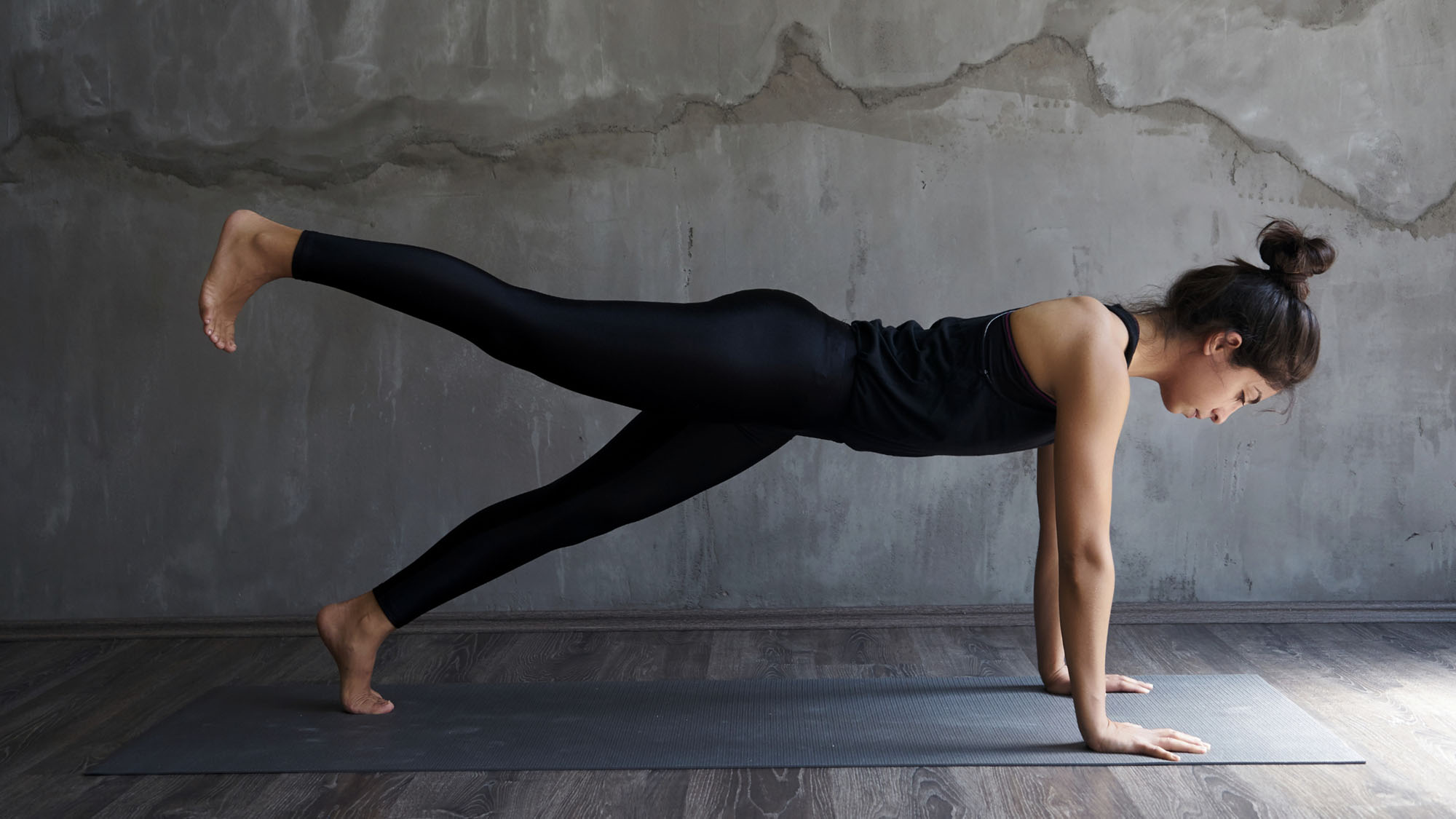


Like every interest or hobby, Pilates has its own vocabulary. And if you’re new (as we all were once), words like powerhouse, imprint, and dorsiflex are foreign and confusing…until they’re not. Once you understand what they mean (both intellectually and physically) the work becomes clearer, steadier, and more connected. And soon these terms – and the movements that accompany them – will be second nature.
Here are 10 common Pilates terms you’ll hear in class…and what they actually mean for your practice.
1. Powerhouse: Where Movement Begins
In Return to Life Through Contrology, Joseph Pilates repeatedly emphasizes that movement originates from the center of the body — specifically the abdominal region, lower back, hips, and pelvis. (He refers to this center as the powerhouse in numerous instructional passages.) When an instructor cues you to “engage your powerhouse,” they’re referring to the center of the body where movement originates: your core.
The powerhouse isn’t about tightening, gripping, or bracing. (Seriously, there’s no gripping in Pilates.) It’s about creating a stable, responsive center so the arms and legs can move freely. When the powerhouse is connected, movement feels grounded and strength shows up without unnecessary tension.
2. Neutral Spine: A Return to Natural Alignment
Neutral spine describes the body’s natural alignment — where the pelvis is level, the ribs stack over the hips, and the spine maintains its natural curves. And your spine does indeed have natural curves. Neutral spine is basically this: Don’t do weird shit with your spine.
Many Pilates exercises begin in neutral to train postural awareness. This alignment supports efficient muscle engagement and minimizes strain. Over time, practicing neutral spine in class influences how you stand, walk, and carry yourself outside the studio. Nothing should feel forced in neutral spine. And everyone’s spinal curvature is different. (See also: Your neutral spine looks different than someone else’s neutral spine so don’t compare.)
3. Imprint: Lumbar Support When You Need It
Imprint is a cue for a gentle posterior tilt of the pelvis that allows the lower back to soften toward the mat. It’s often used during supine (on your back) abdominal work, particularly when the legs are extending (moving away from the body). If we’re not mindful, leg extensions in supine abdominal work can result in an arched (and strained) lower back. Imprint spine helps prevent this.
Again (and again)…there’s no forcing. Imprint is not about forcing the spine flat or pushing it into the mat. It’s a supportive position that helps stabilize the pelvis and protect the lower back. Learning when to use imprint — and when to return to neutral — builds a deeper understanding of spinal control.
4. Bilateral/Unilateral: Two Halves = One Whole
Bilateral movements use both sides of the body at the same time, creating symmetry and shared effort. Unilateral movements work one side at a time, increasing the single-sided muscle demand required for movement and to maintain balance, coordination, and stability.
Unilateral work often reveals imbalances, weaknesses, and bad habits. It asks the body to organize itself more intentionally and requires a deeper level of mind body connection. (IYKYK – right leg extends, left arm bends, left leg extends, right arm bends. Thinking about your to-do list during bilateral work? You’ll be lost and out of sync in no time.) Here’s a shortcut: bi=both and uni=one.
5. Scoop: Deep Support Without Gripping
“Scoop your abs” does not = pulling your stomach in or holding your breath. Scooping refers to a subtle and gently lifting (inward and upward) of the lower abdominals that supports the spine and pelvis.
When scooping is present, movement feels more controlled. Transitions become smoother, and spinal articulation during bridging feels more accessible because the body is supported from the center.
6. Forcible Exhale: Using Your Breath to Support Your Effort
A forcible exhale is an intentional breath out, often cued during the most challenging part of an exercise. (Think *blowing out your birthday candles* or exhale-4-3-2-1 during the Hundred.) It helps activate the deep abdominals and pelvic floor while preventing excess tension in the neck and shoulders. Use it if it works for you. Don’t use if it creates unnecessary and unwanted facial tension (except during the Hundred – definitely use it there). If you can keep your core engaged without it, by all means.
Breath in Pilates isn’t performative — it’s functional.
7. Dorsiflexion and Plantar Flexion: Your Feet are Your Foundation
Dorsiflexion draws the toes toward the shin. Plantar flexion points the foot away. These positions show up constantly in Pilates, especially during footwork on the reformer or chair, feet in straps….everywhere actually.
Articulation of the foot impacts alignment all the way up the body; and how you use your feet influences balance, control, and how efficiently force is transferred through the legs and core. In Pilates, your feet are never passive. Use them wisely.
8. Supine and Prone: Position Changes Everything
Supine means lying on your back (memory hack: supine on your spine). Prone means lying face down (memory hack: there isn’t one, but “Prone” and “Face Down” both have the letter O in them). These positions change how gravity interacts with the body and which muscles are activated during each exercise.
Understanding these terms helps you anticipate what’s coming next. They also help you move with more intention during your transitions. (They’re also super easy to remember, so why not?)
9. Adduct and Abduct: Subtle Actions (Sometimes) – Big Impact (Always)
Adduction draws limbs toward the body’s midline (center). Abduction moves limbs away. These actions play a significant role in pelvic stability and balance, especially during side-lying and standing work. (Think clamshells, leg/arm circles, and any side lying leg lift.)
Though the movement may be small (or not), the effect is substantial. These movement cues help keep the body organized and supported during more complex movement patterns.
10. Lateral Breathing: Creating Space While Staying Connected
Lateral breath refers to the way air is directed into the rib cage rather than the belly. In Pilates, you’ll often be cued to breathe “into the sides and back of the ribs,” allowing the chest to expand while keeping your core engaged. This breathing pattern supports spinal stability and core control, especially during exercises that require sustained abdominal engagement. Instead of the belly rising and falling (like a yoga breath), the rib cage widens and softens with each inhale, then gently draws back together on the exhale. Lateral breathing helps you maintain support through the center without holding your breath, creating movement that feels steady, controlled, and connected rather than tense.
Why Pilates Language Matters
When you understand the cues, you get to stop guessing (yay!). Movement becomes more deliberate, more precise, and more connected. And when the body understands what it’s being asked to do, it responds with confidence rather than *trying harder*.
Pilates terminology isn’t about memorization. It’s about awareness. To be clear, though – you will end up memorizing all of these terms +++. Once you know them, you know them – no need to stress (or create flashcards).

